

Blog
Essential oils for Animals

If you’re still wondering about using essential oils for animals or even just around them, let’s help you settle that question. We’ve already covered a post specifically about essential oils for dogs that you can go through. We will give cautions throughout this article, so keep en eye out for them. Let’s start by mentioning something about caution around pregnancy. Just as you’d be cautious about using essential oils around a pregnant lady, try to also be cautious when doing so around pregnant animals. We suggest to steer clear of all essential oils during the first and second trimester regardless of species. Rather be safe than sorry.
General Guidelines and Dilution Chart
Less essential oil is definitely more when it comes to your pets. We’ve said it before and will say it again. Dilute! And again Dilute! When it comes to animals, with extra sharp senses, this couldn’t be emphasized more. Less is more. It is vital to dilute these concentrated essential oils for animal use even more than usual. What might not irritate you, can possibly irritate them – a lot.
When diffusing essential oils in a room where pets are present, ensure that they have easy access out of the room. Always leave a door or window open for them to freely move in and out as they see fit. This will ensure sufficient ventilation in the room as well. Observe closely for signs of distress or allergic reactions such as excessive drooling or lethargy. However, these reactions should not be present if only a few drops of essential oils are added to your diffuser.
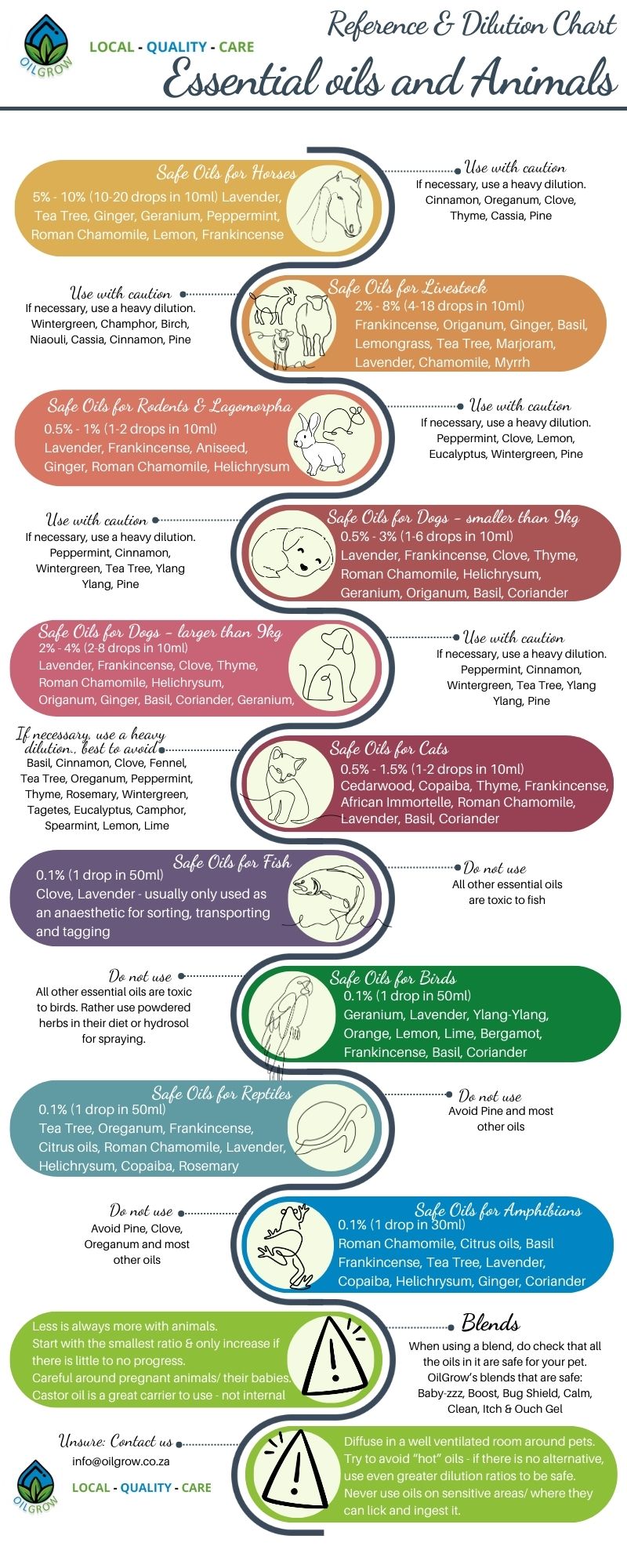
Always dilute the essential oil or essential oil blend in a carrier before you apply it topically. The general rule of thumb for animals smaller than 9kg, dilute 1ml of pure essential oil or essential oil blend in 100ml of carrier oil or cream. That is 1 drop to every 10ml carrier. Rather use the dilution you made, more often than use too much oil in one application. You can safely use a properly diluted oil or blend every 2 hours.Try to start with the smallest dilution percentage. You can always add more essential oil to your dilution if the smallest amount suggested isn’t producing the desired results. Here is an infographic to assist with quick reference. Go ahead, save it and print it for your essential oil box.
Safe oils and their benefits for animals
The following oils are generally considered safe for use around animals of all sorts. Print and save the chart above if you’d like to.
Lavender: Helps animals calm down pretty much the same way it does for us humans. It can be used daily on animals that show signs of serious anxiety. Use during festive seasons when there are fireworks around or even during thunderstorms. Do not give it internally. If it is used as a topical application, always dilute properly. A clever idea is to drip the essential oil on your pet’s collar instead of applying it directly to the skin. This way, the collar can be removed if the oils irritate the dog too much. A drop or three in a diffuser is enough to help calm any indoor pet down. Relieves pain and itching too.
Roman Chamomile: A calming oil also. You can use it the same way you would Lavender. Roman Chamomile also has anti-inflammatory properties. Chamomile can be ingested in a carrier oil only if absolutely necessary.
Cedarwood: This one is useful for repelling ticks and fleas. Dilute with vodka or soapy water in a spray bottle to spray bedding and even on your pet’s back. Be cautious to not do this on animals that lick themselves in order to stay clean – cats, bunnies and mice or guineapigs. Rather spray it on their bedding or around the cage.
Frankincense: is safe for internal use and therefore, when you use it, always diluted, it’s okay to use small amounts directly on the animal’s fur or skin. This oil supports immune health so feel free to add a bit into their diet every now and then. It is known to be helpful in treatment of anxiety, pain and inflammation and even wound cleaning.
Myrrh is also safe for internal use. It is also a wonderful wound cleaner and healer. So dare to use this on any minor wounds your animals might have to endure. It is known to be helpful in killing off bacteria, fungus and parasites. It might even help with proper oral health. Use wisely – always diluted in the proper ratios.
Helichrysum or African Immortelle soothes skin irritations on animals quite well when diluted in a carrier oil such as Castor Oil. It can even assist with the pain they might experience. It can be used for wound care in animals and assist with their nervous system health.
Marjoram is safe to use on all species of animals. It is very soothing and calming to their nervous system and provides digestive and pain support.
Copaiba is very versatile and safe for all species. It supports cardiovascular, digestive, urinary, respiratory, musculoskeletal, and nervous system health. It can even assist in keeping your pets’ fur and nails/ hooves healthy.
Tagetes is a natural insect repellent and can safely be used, diluted on all animals except for cats, birds and fish.
Clove is a natural insect repellent, topical analgesic and antibacterial. It is a hot oil so take caution to dilute this one properly – start with very little and only increase if necessary. Did you know that Clove oil can be used as a natural anaesthetic in fish?! It is often used in procedures like immobilization, handling, sorting and tagging. You can read more about that in this study. You can use Clove oil with ease as a natural alternative for insect control in livestock. Some people report using it as a natural pain reliever for dogs. It has also proven beneficial to improve digestion and overall health of various animals.
Thyme is a hot oil, so again, be cautious at first and use the smallest dose. It is a natural insect repellent and antibacterial oil.
Origanum, although considered a hot oil and should be used with caution, has been successfully tested on calves right here in South Africa. Minlé, one of our Resellers, have had trouble with her calves before and this time round, she came prepared with some anecdotal evidence that essential oils can help. Usually, when the calves are taken from their moms they tend to struggle with their digestive systems that can lead to fever and eventually death. They used the proper dilution of Origanum in their milk and the calves responded brilliantly. Their digestive issues sorted out and it didn’t end up in fever and death.
Castor Oil is considered safe for all animals for external use. Do not give it internally since it can cause diarrhea. One of the OilGrow Resellers have successfully treated a cancerous growth on the face and in the eye of a sheep on her farm. After about 2 months’ usage, the cancer in the face disappeared and the eye was clear and seeing again. To us this was a remarkable testimony to have.
Safe and Unique OilGrow blends
Baby-zzz massage oil: Can be used on all animal species except for birds and fish. Contains both Lavender and Roman Chamomile in a grapeseed oil carrier. Apply a little bit of this oil to the back of the neck or the chest of the dog to help relax the animal. This is wonderful for almost anything. Mosquito bites, burns, cuts, all insect bites, pain and even tired legs.
Boost blend: this one can, with proper dilution and caution be used successfully for livestock health such as immune support, mastitis, coccidiosis, caseous lymphadenitis, abscesses, bacterial or viral infections, hoof conditions, general herd health. Boost is safe for ingestion by humans, we suggest contacting an Aromatherapist to check the safety for animals. It contains most of the single oils mentioned above except for some citrus ones too. So just check which animal you could posibly use it on.
Bug Shield – can be used topically – diluted. You can use it on all species except for cats, birds and fish. Also use the Bug Shield Spray to spray their bedding. We have a soap bar that can be used to wash them with, as well as a lotion that can be used on their spines to help prevent ticks and fleas from climbing on them. It will deter stable flies from the areas where horses roam. Great for getting rid of head lice completely. One of our resellers reported that it even assisted her with pain relief in her legs. The essential oils in Bug Shield that is known to assist with pain: Eucalyptus is anti-spasmodic, Rosemary is anti-inflammatory and assists with circulation. Clove Bud is a topical analgesic so will assist with relieving pain. You can use it on horses that do competitive sports too – you’ll be amazed how it assists to relieve their tired muscles. The latest mango-fly outbreak is also not an issue – you can easily use Bug Shield to keep them away from your skin.
Plump Lip balm is wonderful to help form a barrier against the elements with scrapes and wounds.
Calm – diffuse in a room where they can freely move in and out. Can also be used, diluted, to rub behind their ears. This blend contains Roman Chamomile, Lavender and Marjoram and is safe to use on all species of animals. This one helps with jittery, anxious, skittish animals, especially for traveling or with loud noises. It is also excellent for allergy skin conditions.
Itch & Ouch – this is a unique OilGrow Gel with Devil’s claw and Ginger essential oil in. The product is safe for accidental ingestion by animals. It is a wonderful anti-inflammatory and works wonders on wounds – even open wounds. Although caution should be taken with the hot oils the ginger in this one is of such low quantities that it is honestly even safe to use on open wounds, sprains and infections.
Shampoo bar: Contains Cedarwood and other essential oils along with Shea butter and Coconut oil. Not only will it improve their hair growth and condition of their fur coats, it will also keep ticks and fleas away as a bonus. It is an alternative for Bug Shield if you only have this one in hand.
Essential oils for animals that should be used with caution
In general it is wise to avoid using hot oils on animals. We suggest that you do use it when necessary, but very cautiously and always start with the lowest suggested dose. The following essential oils shoud be used with caution because they are hot oils: Cassia, Cinnamon, Clove, Oreganum, Thyme
Eucalyptus and Rosemary should be used with caution because it contains 1,8-cineol – use in very small dosis. Our Bug Shield blend contains these but in very low dosage and can therefore be used as per the dilution chart.
These oils should just be avoided in general: Pennyroyal, Wintergreen, Pine, Birch and Ylang Ylang. If you wanted to know more specifics about oils pertaining to certain types of animals, perhaps visit Dr. Janet Roark’s site and read more on safety for the various animals there. She sets the information out in so much detail and her experience with animals and essential oils are of immense value.
Methods of application
We’ve set out some information on essential oils for animals but how do you best apply these oils once properly diluted? Firstly, when applying topically, again, always diluted according to the suggested dilution chart, only do so if you know the animal won’t reach the area and lick it. Applying to a horse’s skin is much different than applying to a cat’s. Application is usually safe if the area could be bandaged without the option that the bandage can be ripped off. Application to the skin: not close to eyes, ears, nose, mouth or genitals because the skin is too sensitive. Apply to their necks, back tips of the ears, backs or collars it they wear any.
Diffuse the oils – that usually is quite fine. Do check that there is proper ventilation in the room and that the animal can get out if they wish to. When using a diffuser around birds that are in a cage and cannot escape, always put the diffuser far away from the cage and keep a vigilant eye on them for signs of distress.
Perhaps, under the guidance of an Aromatherapist, some essential oils could be given internally to your pets and livestock. We’ve tested origanum with success. Again, proper dilution is essential and let’s check in with an Aromatherapist about which oils can be used and how.





 Reach us on WhatsApp